Encounters
A small collection of reflections on the practices of Studio Somnus.
Attention is the rarest and purest form of generosity.
Simone Weil
Threshold Sketches
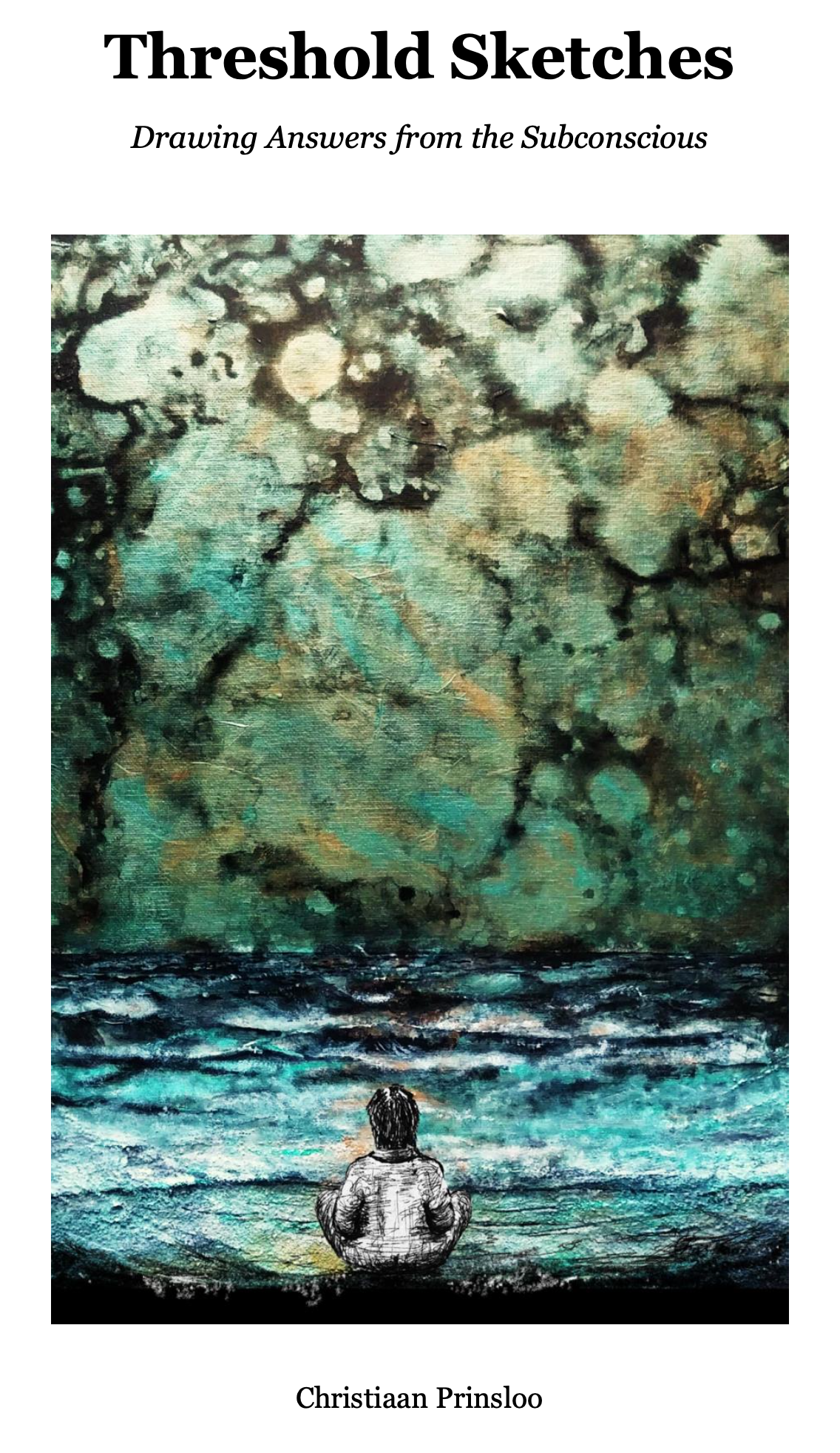
Threshold Sketches: Drawing Answers from the Subconscious Mind
Threshold Sketches is offered freely as a PDF, for personal use and unaltered sharing. No account or fee is required — the work is meant to find whoever may be looking for it.
The book was designed to be drawn in, physically or digitally. Each sketch opens with a prompt, leaves room for a drawing, and closes with space for dated reflections that can be returned to across the seasons of a life. The physical act of putting pen to paper is part of the practice, and over time, the printed book becomes something a screen cannot become: a record of your own inward work, in your own hand.
A digital copy read on a tablet is welcome for those who prefer it. For printing, the PDF is formatted at A4. If your paper is a different size, select "fit to page" or "scale to fit" in your print dialog — Letter and A4 can be printed this way interchangeably without losing any content.
On Bibliotherapy
Three Essays
Why does a story reach the very place that needs reaching? This collection follows that question in two movements. Three essays draw on my research into therapeutic reading, and on the readers who took part in it, to trace what happens between a person and a text: recognition, distance, and threshold. A fourth piece then puts the method on display, reading a single short story by H. G. Wells slowly, the way I read with students and clients. The story itself is here too, whole, for you to read before anyone tells you what it means.
Recognition: How a Story Finds Us
-
Recognition: How a Story Finds Us
Essay one of three on bibliotherapy
Christiaan Prinsloo
Above the entrance to the ancient library at Thebes, carved where every visitor would pass beneath it, stood an inscription: the healing place of the soul.1 The claim is remarkable less for its age than for its confidence. It does not promise that the library consoles, or distracts, or instructs. It says that something in the meeting of a person and a text heals, the way water simply quenches thirst, and it assumes the reader already knows how. Three thousand years later, we have libraries beyond the dreaming of Thebes, and we have mostly forgotten what its stonemasons took for granted.
Yet the experience itself has not gone anywhere. A person who finds themselves steadied by a story in a difficult season will often struggle to say what happened. The book was not about them. The characters lived elsewhere, in other centuries, under other names. And still something in the reading found its way in, the way water finds the one crack in a wall, and reached the very place that needed reaching. My research on bibliotherapy began with this ordinary mystery: what must pass between a reader and a story before the story can do its quiet work?2
The answer begins with a single act: recognition. Before a text can move us, we must recognize something of ourselves already living in it. Psychologists who study therapeutic reading describe a process with three movements: identification, catharsis, and integration.3 The reader first finds themselves in the story; then feels, at a safe remove, what could not be felt directly; and finally returns to their own life carrying a new understanding of it. Everything rests on the first movement. Without recognition, the most beautiful book in the world remains a closed door, admired from the street.
Every reader already knows this from the inside, because every reader has abandoned a book. We begin with good intentions; the novel is celebrated, the friend who pressed it on us was sincere. And still, by page fifty or eighty, we set it down with a vague sense of guilt and never pick it up again. We tend to blame our discipline, or the season, or the book. But often what has happened is simpler and more forgivable: we never found ourselves in it. We stood in its rooms like a guest at a stranger's party, met no one we knew, and quietly left. The failure is not of attention but of recognition, and recognition cannot be forced. This is worth knowing, because it turns a small private embarrassment into information: the books we cannot enter tell us nearly as much about our inner weather as the books we cannot put down.
What makes recognition possible, when it does occur, is rarely deliberate. We do not decide to see ourselves in a character; we discover that we already have. The psychologist Caroline Shrodes, writing in the middle of the last century, understood this as a form of projection: the reader lends the story their own fears, losses, and longings, often without noticing the loan.4 The story does not describe our circumstances. It receives them, as still water receives a face. And what it receives, it holds at a slight distance, where, perhaps for the first time, it can be looked at rather than merely endured.
I watched this happen in my own study, most vividly among readers of Porcelain (Henrietta Rose-Innes), a story that lives inside the weather of a woman's mind without once reaching for a clinical word. One reader noticed precisely this: “By portraying Celia, not in medical or professional terms (notice how the term ‘bi-polar’ never appears in the story), the author makes her seem like an everyday person that might be living with us.”5 Another reader wrote that the story “gave me a totally new sight on how to view mood disorders and various emotions related to it.” Between them they name the first gift of literature, the one no diagnostic manual is built to give: it shows us the person before the condition, a face before a category. And it is faces, not categories, that we recognize ourselves in.
What, then, do readers actually recognize? In my study, the doorway was almost always a character. Every participant, without exception, wrote about the people in their chosen stories before anything else; one began her reflection simply, “The first element that I could identify with was that of Akira and Yoshiko” in Melancholy Nights in a Tokyo Cyber Café (Sequoia Nagamatsu). But the character is only the threshold. What readers found through these figures was their own emotional life: depression, isolation, fear, the ache of love sought in the wrong places. One reader traced the whole chain in a sentence, writing that isolation had been among the causes of her depression, and that “because of that, I felt like I was not getting enough love and attention from other people.” She had not found her biography in the story. She had found her feeling, wearing someone else's life.
And with the feeling came something unexpected: company. “Reading these stories felt like therapy sessions,” one reader reflected, “because I came to know that I'm not the only one suffering from these kinds of problems. Beautifully written sentences whispered that it is all right to be immature; it's completely normal to feel so wrong about myself sometimes just like Akira and Celia did.” Notice what has happened in that sentence. A young woman in Seoul has been kept company by a man in a Tokyo cybercafé and a woman on South Africa's Western Cape coast, neither of whom exists. Recognition has quietly abolished the loneliness that so often surrounds suffering; not by argument, but by presence.
There is one further gift, and it is the strangest. Recognition brings us close to a character, yet the closeness produces perspective. One reader, who had identified deeply with Akira's self-imposed isolation, put it with a precision I have not been able to improve upon: “In the process of identifying myself with Akira, I was able to view my depression history in a more detached way. This means that I became not soaked in my depression, instead I became able to face my struggles during depression and recognize the value of my power for survival.” Not soaked: the image deserves a pause. Inside our own suffering we are submerged in it, and one cannot examine the water one is drowning in. The story lifts the reader just clear of the surface. From there, still close enough to feel everything, she could finally see; and what she saw, to her surprise, included her own strength.
This is recognition's full arc: a character opens the door, a feeling is received and held at arm's length, loneliness loosens, and the self becomes visible to itself. None of it can be commanded, but all of it can be invited, and the invitation is largely a matter of finding the right text. Which raises a question the reader may already have felt stirring. The readers in my study were young Koreans; the stories that found them were set in Tokyo, on the Western Cape coast, and elsewhere, written in a foreign language, peopled by strangers. By every conventional measure, these were the wrong books, the ones they should have abandoned by page fifty. Why the unfamiliar story so often sees us most clearly is the question the next essay takes up.
Notes
1. The inscription at the library of Thebes is recounted in D. McCulliss, “Bibliotherapy: Historical and research perspectives,” Journal of Poetry Therapy 25, no. 1 (2012): 23–38.
2. C. Prinsloo, Biblio- and Music Therapeutic Identification Among Highly Educated Korean Emerging Adults in a Heterogeneous Context (master's thesis, Harvard University, 2024).
3. The three-movement model is developed in C. Bailey (1984) and J. Pardeck, Using Books in Clinical Social Work Practice (1998).
4. C. Shrodes, “Bibliotherapy: A theoretical and clinical-experimental study” (PhD diss., University of California, Berkeley, 1949).
5. Reader reflections quoted in this series are drawn verbatim from the study cited in note 2. Identifying details are withheld to protect participants' anonymity.
© Christiaan Prinsloo · Studio Somnus. All rights reserved.
These essays form part of a teaching practice. To bring this work to your classroom, institution, or reading circle, inquire privately. text goes here
Distance: Why the Unfamiliar Text Sees Us Clearly
-
DescrDistance: Why the Unfamiliar Text Sees Us Clearly
Essay two of three on bibliotherapy
Christiaan Prinsloo
There is a piece of received wisdom in therapeutic reading, so intuitive that it is rarely examined: to reach a reader, choose a story that resembles them. The professional literature makes the intuition explicit. Texts should be plausible to the reader's circumstances, should offer a believable common experience, should mirror their culture and language.1 The therapist, in this tradition, is a kind of matchmaker, and the match is made on likeness. Give the grieving reader a story of grief in a house like hers, in a language like hers, among people like her people; recognition will follow as spring follows winter.
The logic is warm, and it is not entirely wrong. But likeness has a shadow, and the clinical record contains a cautionary tale about it. A therapist once treated a patient with whom she shared a South American history, and precisely because of that kinship she trusted what she recognized: she read the man's crisis through their common experience of political repression, and in doing so missed what was actually wrong. Only a later assessment found the illness the resemblance had concealed.2 Likeness had not opened a window; it had silvered it into a mirror, and the therapist saw herself where her patient stood. What is true in the consulting room is true on the page. The story that matches our life too neatly can show us only what we already believe about it.
My own research began where this doubt leads.3 Rather than matching readers to texts, I did the reverse: I invited young Korean readers to sit with stories that mirrored nothing of their outward lives. A Zimbabwean family coming apart in Petina Gappah's London. A century-old English story by Katherine Mansfield, all drawing-room restraint and unspoken feeling. A woman's turbulent inner weather on South Africa's Western Cape coast. If the matchmaking doctrine were the whole truth, these readers should have stood politely outside every one of these stories and, by page fifty, quietly left. That is not what happened.
One reader, holding Gappah's fictional family up against her own, wrote: “Even though Tonde's family seems like it is only a fiction, I'm convinced that there are thousands of families in our society that resemble their dysfunctional family dynamics. My family was also really similar to them, especially in 2020, when Covid struck South Korea hard.”4 A Zimbabwean household in London had shown a young woman in Seoul her own kitchen table. Another reader, of Mansfield's Psychology, written a hundred years and half a world away, stated plainly: “The story deeply relates to my own experiences, and I strongly identify with the two main characters, the woman and the man.” Nothing in these texts matched these readers, not nation, not language, not decade. And still the stories found them, as essay one described: the crack in the wall does not ask where the water was drawn.
It was a third reader who turned the finding into a question, and her question is the reason this essay exists. “Why am I agitated by the emotions of fictional characters with completely different backgrounds from mine?” she asked, genuinely puzzled at her own tears. She had noticed, from the inside, that the doctrine of likeness could not explain her. Something in her had answered a stranger.
The beginning of an answer is that we have been matching on the wrong layer. Circumstance is the clothing of a life; feeling is the body underneath. Nation, language, decade, custom: these are what a story wears. What it is, underneath, is fear and love and grief and the hunger for meaning, and at that depth there are no foreigners. My readers did not identify with Shona custom or Edwardian tea; they identified with a family straining under money and silence, with two people unable to say the one necessary thing. The distant text and the near reader met where all texts and all readers meet, in the small country of the human heart, which has no borders and needs no passport.
But this only explains why distance is no obstacle. The stranger claim of my research is that distance is an advantage, and the reason lies in what likeness does to our defenses. A story set in our own city, among people of our own kind, arrives pre-judged; we know too well what we think of such people, because we are such people, and our settled opinions stand at the door checking every feeling for identification papers. The unfamiliar story slips past this checkpoint unexamined. We lower our guard for a Zimbabwean family in London precisely because they could not possibly be us; and then, in the undefended quiet, we discover they are. The distant mirror shows us what the near mirror cannot, for the same reason a photograph of a stranger's hands can suddenly show us our mother's: we were not braced for it.
There is a second advantage, quieter still. The near text invites comparison; the distant text invites contemplation. When a story matches our life, we audit it, checking its details against our own, and the auditing keeps us on the surface. When nothing matches, there is nothing to audit, and attention sinks. The reader I quoted in the first essay, who found she could view her depression “in a more detached way” through a character in Tokyo, was describing exactly this: the story's foreignness gave her somewhere to stand that was not inside her own suffering. Distance on the page became distance within, the reflective distance in which a life can finally be seen rather than merely lived.
I will make the claim plainly, because my practice rests on it. When I curate a text for a client, I am not matchmaking, and I am deliberately not reaching for the story that resembles their life; resemblance, we have seen, can flatter, and flattery conceals. I am looking for the story distant enough to receive their life without echoing it, the text a client would never have chosen from the shelf of their own circumstances, because it is precisely there, in the undefended encounter with the unlike, that recognition does its deepest work. The stories that found my readers were, by every conventional measure, the wrong stories. Choosing the right wrong story is a craft, and it is the craft this research taught me.
And it opens onto one further mystery. My readers did not stop at feeling. Having passed through the unfamiliar story's rooms, many of them kept walking, past emotion, past even self-understanding, into questions no one had assigned: what a life means, what is real, what remains. One began his reflection with a sentence that could open a philosophy seminar: “People crave for existential values.” Where reading finally leads, when it leads that far, is the subject of the last essay.
Notes
1. Selection criteria of this kind are set out in A. Hynes and M. Hynes-Berry, Biblio/Poetry Therapy: The Interactive Process (2012), and D. Pehrsson and P. McMillen, “Bibliotherapy: Overview and implications for counselors” (2007).
2. The case is reported in L. Comas-Díaz and F. Jacobsen, “Ethnocultural identification in psychotherapy,” Psychiatry 50, no. 3 (1987): 232–241.
3. C. Prinsloo, Biblio- and Music Therapeutic Identification Among Highly Educated Korean Emerging Adults in a Heterogeneous Context (master's thesis, Harvard University, 2024). Preliminary findings appeared in C. Prinsloo and A. Prinsloo (2021).
4. Reader reflections quoted in this series are drawn verbatim from the study cited in note 3. Identifying details are withheld to protect participants' anonymity.
© Christiaan Prinsloo · Studio Somnus. All rights reserved.
These essays form part of a teaching practice. To bring this work to your classroom, institution, or reading circle, inquire privately.iption text goes here
Threshold: Where Reading Finally Leads
-
Threshold: Where Reading Finally Leads
Essay three of three on bibliotherapy
Christiaan Prinsloo
The first essay in this series described how a story finds us: through recognition, the discovery of our own inner life already living in a stranger's. The second described which stories find us most deeply, and why the unfamiliar text so often sees us more clearly than the familiar one. Both essays end, if we are honest, where most accounts of therapeutic reading end: in relief. The reader feels less alone; the suffering becomes visible and therefore bearable; the story has done its work. It is a good ending. It is simply not where my readers stopped.1
Nothing in my study asked them to go further. The writing prompts were deliberately plain; they did not mention emotion, let alone meaning or existence. And yet, having passed through recognition and out the other side, reader after reader kept walking, into territory no one had assigned. One opened his reflection with a sentence of startling directness: “People crave for existential values.” He was not summarizing the stories; he was confessing, as he wrote later, that “existential values were a personal problem for me.” A story about a man in a Tokyo cyber café had brought him, unprompted, to the oldest questions there are.
He was not alone, and the questions the readers reached were not vague. They were the precise, ancient ones. What is real: one reader, thinking through how fiction had moved her, arrived at a small epistemology of her own: “Usually in real life, emotions are conveyed not by emotion itself but by the intake of our visual and auditory senses.” What is time, and what does it do to pain: another reader wrote, “They say that memories possess a peculiar allure, their intrinsic beauty derived solely from just their being as memories. Even the most painful recollections can become the most treasured ones when revisited.” These are not the sentences of people seeking symptom relief. They are the sentences of people who, having entered a story for comfort, found themselves standing somewhere with a much longer view.
What strikes me most is the doorway through which they passed: beauty. The reader who loved Porcelain said so in words I have returned to many times: she loved the story “both as an object of appreciation and an expansion of my sight.” Notice the order. First the appreciation, the sheer pleasure of a made thing; then, through it, the expanded seeing. The philosopher Maurice Merleau-Ponty spent his life arguing that perception is not a window we look through but a fabric we are woven into, so that what we perceive alters the perceiver.2 My reader compressed the argument into six words. The story had not given her new information. It had changed the instrument, and she left the story literally seeing more than she brought to it.
And what the enlarged sight fell upon, again and again, was meaning. Viktor Frankl, who built an entire school of therapy on the conviction that the human being is moved less by pleasure or power than by the will to meaning, held that suffering becomes endurable at the moment it means something.3 My readers enacted his claim without ever having read him. One, reflecting on his own failures through a story, found that “[t]hese failures became stories that create bonds of understanding”: pain, given narrative form, converted into connection. Another concluded that “time exerts its transformation power of old, painful memories as catalysts for personal growth.” In each case the movement is the same. The story does not remove the suffering. It offers the suffering a place in a larger pattern, and a pain that has a place is no longer only a pain.
In my research I gave this far region of the reading experience a name: the liminal zone. It resists the tidy stages with which therapeutic reading is usually mapped; it is neither the first recognition nor the final integration, neither fully conscious nor unconscious. It is the region where the aesthetic and the existential meet, where a reader stands momentarily outside the ordinary boundaries of their life and glimpses it whole. In my study, music also reached this region, but by the opposite road: listeners slipped beneath language, touching what my thesis could only call something more significant than the Self at precisely the point where words gave out. Readers arrived by going all the way through words: interpretation pressed further and further until, like a door pushed past its frame, meaning opened onto what meaning cannot contain. This is literature's distinct genius. It does not bypass the mind on the way to the depths. It takes the mind along.
Liminal comes from limen, the Latin word for threshold, and I have come to believe the image is exact. A threshold is the one part of a house that belongs to no room. Standing in it, one is neither inside nor outside, no longer where one was and not yet where one is going. That is where reading, followed far enough, finally leads: not to an answer but to a standing-place, a pause between rooms from which a life can be seen in both directions. My readers entered stories about strangers and ended up at the doorway of their own existence, looking back at what their suffering had meant and forward at what their lives might yet mean. No one sent them there. The stories simply walked them, page by page, to the threshold, and waited.
I have watched people arrive at that same doorway by other roads. They come to my practice at thresholds of their own: a loss that has rearranged everything, a transition between one life and the next, a stagnation that is really a door not yet noticed. It is why the word threshold sits at the center of my practice's vocabulary, and why bibliotherapy belongs there. The work is not to manufacture the threshold; life supplies those without assistance. The work is to keep a person company there, and for that there are few companions steadier than a story: something made and beautiful, distant enough to receive a life without echoing it, patient enough to wait while sight expands. The right story does not tell a person standing between rooms what to do. It stands there with them, and holds the lamp.
Perhaps this is what the stonemasons of Thebes understood when they carved their inscription above the library door, where this series began. The healing place of the soul: not, I think, because the scrolls inside repaired anything, but because a library is a house made entirely of thresholds, every story a doorway, every doorway an invitation to stand for a moment between the life one has and the life one has not yet seen. Healing, at that depth, is not the closing of a wound. It is the opening of a view.
Notes
1. The findings discussed in this essay are drawn from C. Prinsloo, Biblio- and Music Therapeutic Identification Among Highly Educated Korean Emerging Adults in a Heterogeneous Context (master's thesis, Harvard University, 2024). Reader reflections are quoted verbatim; identifying details are withheld to protect participants' anonymity.
2. M. Merleau-Ponty, Phenomenology of Perception (1945).
3. V. Frankl, Man's Search for Meaning (1946).
© Christiaan Prinsloo · Studio Somnus. All rights reserved.
These essays form part of a teaching practice. To bring this work to your classroom, institution, or reading circle, inquire privately. text goes here
A Reading
-
The Pearl of Love: A Reading
A companion piece to the three essays on bibliotherapy
Christiaan Prinsloo
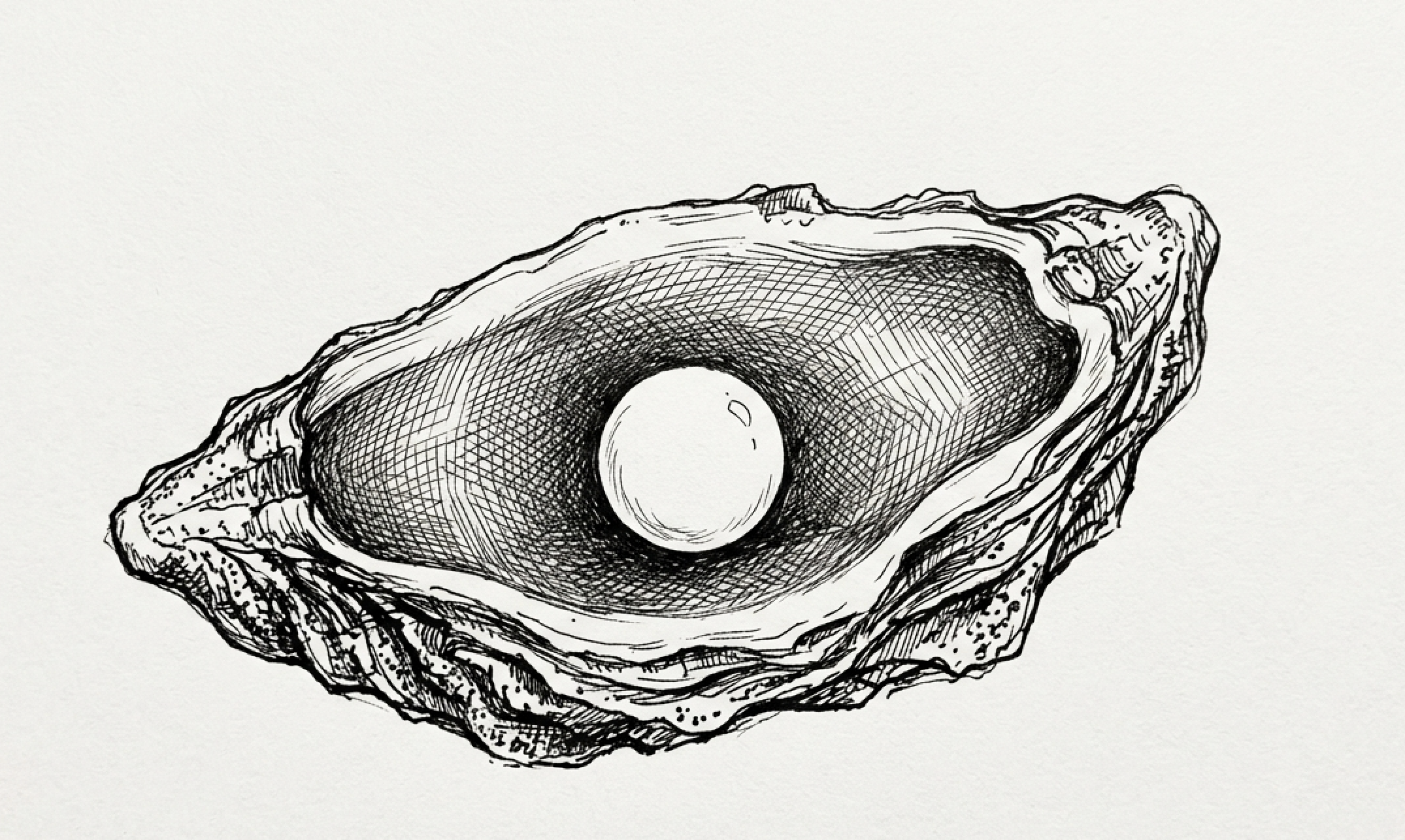
The three essays that precede this one describe what happens when a person reads: recognition, distance, threshold. Description, though, is not demonstration. So here is a single story, read slowly, the way I read it with students and with clients; a small exhibition of the method at work. The story is H. G. Wells's “The Pearl of Love,” from 1925, and it runs to barely two thousand words; you may read it whole before continuing, and that is the better order, since a story deserves to happen to you before anyone tells you what it means.1 What follows is my reading. The story, as we will see, was built to survive many.
Wells opens not with the tale but with a frame, and the frame is a trap laid with great courtesy. A moralist declares that “the pearl is lovelier than the most brilliant of crystalline stones... because it is made through the suffering of a living creature.” The narrator shrugs; pearls do not move him. Then he confesses that he cannot decide “whether The Pearl of Love is the cruelest of stories or only a gracious fable of the immortality of beauty,” and hands the story over to us with the question unresolved. Notice what has been done. Before a single event has occurred, we have been told the story has two readings, one cruel and one gracious, and that the deciding falls to the reader. Wells even invents a provenance for this indecision: the tale is presented as medieval Persian prose, already buried under centuries of commentary, read as poetic invention, as allegory, as theology, as parable, and by some as “the statement of a fact, simply and baldly true.” A story that arrives pre-interpreted is a story about interpretation. And one word in the frame winks at us. The immortality of beauty stands a single letter from the immorality of beauty, and I take the near-miss to be deliberate: the two readings the narrator cannot choose between are folded into one word and its shadow. Whether beauty immortalizes or corrupts is precisely what the story will refuse to settle for us.
The tale itself begins as the oldest of tales. A young prince in North India, a maiden of “indescribable beauty and delightfulness,” a love “full of joys and sweetness, full of hope.” Wells gives them a year and a part of a year; then “because of some venomous sting that came to her in a thicket, she died.” Any reader will hear the Taj Mahal behind what follows, Shah Jahan raising the great mausoleum for Mumtaz Mahal, and Wells surely intends the echo. But watch the landscape he builds first, because he has hidden the ending in it: a country of sunshine and lakes and fertile valleys, and “far away the great mountains hung in the sky, peaks, crests, and ridges of inaccessible and eternal snow.” The mountains are there before the love, before the grief. The story knows where it is going two thousand words before the prince does.
Grief arrives, and with it the story's first movement, which I will call going in. The prince lies two days and nights on his face. Then he rises “like one who has taken a great resolution,” and the resolution is enclosure: the queen's body in a coffin of lead mixed with silver, that coffin inside precious scented woods inlaid with gold, and around it all a sarcophagus of alabaster inlaid with precious stones. Box within box within box; grief as concentric containment, as if love's remaining work were to wrap what it can no longer hold. He spends these days “brooding upon her loveliness,” and the phrase is exact, for brooding is what encloses. Yet Wells plants a strange detail: the prince refuses sackcloth and ashes, “for his love was too great for such extravagances.” Too great for the customs of grief. Something in this mourning does not intend to behave like mourning, and the story has begun to tilt.
The prince announces his monument, “a building of perfect grace and beauty, more marvelous than any other building had ever been or could ever be,” and names it the Pearl of Love. Recall the frame: the pearl is beauty made through suffering. The building is named as the story's own thesis. And its foundation is “cut out of the living rock,” a phrase worth pausing on: living rock, for a dead queen, in a place chosen for one quality above all, that from it “one seemed to be looking at the snowy wilderness of the great mountain across the valley of the world.” Before a single pillar stands, the site has been chosen for its view. The prince does not know this yet. The story does.
Now stay with paragraph eight a moment, because it is the spine of the whole, and it is a spine made of color. The young prince's first designs are encrusted: pierced screens, “delicate clusters of rosy-hued pillars,” a first dome of green tiles framed in silver, gold-lined brightness, and at the center “the sarcophagus lay like a child that sleeps among flowers.” Warm hues, filled space, ornament pressed upon ornament; matter answering death with more matter. But year follows year, and Wells tracks the man's inner life entirely through his palette: “His sense of color had grown finer and colder; he cared no more for the enameled gold-lined brightness that had pleased him first; he sought now for blue colorings like the sky and for the subtle hues of great distances, for obscure shadows and sudden broad floods of purple opalescence and for grandeur and space.” Read that sentence as a biography, because it is one. Gold to blue; warmth to coldness; nearness to “the hues of great distances”; things to space. “Those were pretty things,” he says of his earlier decorations, and puts them away. This is the trajectory I ask my students to trace: the building is the prince's psyche rendered in stone, and its renovations are his development. He began by filling space, the response of the body, of the tangible, of grief that grips. He is learning, decade by decade, to empty it: the movement from the corporeal toward whatever the corporeal opens onto.
The story is set in India, and within the traditions of its own soil the palette's ascent has a further precision. In the yogic map of the subtle body, the map of the chakras, the warm colors belong to the root of things, to embodiment and ground, and the cool ones, the blues and indigos of great distances, to the centers of vision at the brow and crown. Whether Wells knew this map or merely painted truly, his prince climbs it exactly: a man whose colors rise, across the decades, from the red-gold of the rooted body toward the indigo of seeing. The crowd outside senses the change without understanding it. “Wonderful are the miracles,” they whisper, “that love can do,” and the women love the prince for “the splendor of his devotion.” They think they are watching a man remember a woman. They are watching a man be remade.
Then comes the vista, and the story's second movement, going out. “Through the middle of the building ran a great aisle, a vista that the prince came to care for more and more,” until from the inner entrance his gaze travels “along the length of an immense pillared gallery,” across the space where the rosy pillars have long since vanished, “over the top of the pavilion under which lay the sarcophagus, through a marvelously designed opening, to the snowy wildernesses of the great mountain, the lord of all mountains, two hundred miles away.” Follow the grammar of that sentence: it enters the building only to leave it, and the eye is carried over the queen on its way to the snow. The building has quietly changed kind. It began as a container, box within box around a body; it has become an instrument of seeing, a line of sight two hundred miles long.
The Taj Mahal, whose memory stands behind this story, keeps the same secret. Its wonder is not finally in the encrustation, exquisite as the inlaid stone is, but in its composition of emptiness: the long axial approach, the framed and repeated sky, the void the great dome holds. Anyone who has walked that axis has performed the prince's vista in miniature. The architecture of the subcontinent has always known what the prince spends his life learning, that the spaces between and beyond the stone are not what the building fails to fill but what it exists to shape.
Wells names the vista's new inhabitants: pillars and arches “perfect yet unobtrusive, like great archangels waiting in the shadows about the presence of God,” an “austere beauty” before which men are exalted, then shiver, then bow. And when the prince at last has the pavilion itself dismantled, the onlookers reach for the only explanation large enough: “It was as if the God of nature's beauty had taken over their offspring to himself.” Which god is that? Not the god of any temple in the story. A god whose name is nature's beauty, standing at the end of an aisle of archangels, wearing eternal snow.
Wells's own titles carry the ascent. She enters the story a maiden and is made a queen; the prince who crowns her is never once called king, so that from her first sentence she stands above the story that holds her. In death the title rises again: she is “the queen, the dear immortal cause of all this beauty.” Cause, now, not occupant. Maiden, queen, cause: the woman climbs through the story's nouns as the building climbs through its colors, and both ladders lean against the same sky. I will say plainly what I hear in this, and it is mine, not provably Wells's: the queen has not been left behind by this building; she has been distributed into it. The loveliness the young prince brooded upon in one body, the older man has learned to see everywhere the building looks. She has passed from the contained to the uncontainable, from a form to a radiance, the way the beloved dead do in a mourner who has mourned all the way. The feminine has not vanished from the story. It has become the view.
And so to the ending, which is where the two readings of the frame finally separate, and where I must be fair to the one I do not hold. “Only one thing there was to mar the absolute harmony.” The sarcophagus, never enlarged since those early days, now “challenged the eye; it nicked the streaming lines.” Inside it, Wells reminds us with terrible gentleness, is “the queen, the dear immortal cause of all this beauty,” and yet it has become “a little dark rectangle that lay incongruously in the great vista of the Pearl of Love. It was as if someone had dropped a small suitcase upon the crystal sea of heaven.” The prince muses long; no one knows his thoughts. “At last he spoke. He pointed. ‘Take that thing away,’ he said.”
The cruel reading, and it is a serious one, says: here is the immorality of beauty. The work has devoured its occasion; the monument to love has perfected itself past love; the artist has forgotten the woman in the art, and her body is now that thing, luggage on the floor of heaven. On this reading Wells has written a cold parable about aesthetics eating grief, and the story's last line is the sound of a heart finishing its own petrification. I give this reading its full weight in every seminar, because it is true to the words on the page and because some readers need it to be the meaning; we will come back to why.
But set beside it what the whole story has been doing. Every movement has run one direction: from filled space to empty, from gold to blue, from nearness to distance, from body to view, from going in to going out. The site was chosen for the mountain before the first stone was laid. The vista is not a betrayal of the design; it is the design, discovered slowly, the way a life's meaning is. And a threshold, as the third essay in this series argued, is the one part of a house that belongs to no room; one cannot stand on it and keep the furniture of the old room around one's feet. The sarcophagus is the last piece of going in left in a building that has become entirely going out. On this reading, “Take that thing away” is not the eviction of the beloved but the completion of her transformation: the casket was only ever the chrysalis, and one does not leave the chrysalis in the middle of the room once the thing it held is in the air. The prince's gaze goes through the building, past where her body lies, to the eternal snow; in the traditions of those mountains the far ranges hide the blessed realm, and though Wells never names it, I confess I see it there, the lord of all mountains standing where the story needs a beyond. Grief, followed all the way, has turned into vista. The building is finished the moment there is nothing left in it to look at, and everything to look through.
Which reading is right? Here is the point of the exhibition: the story will not tell you, because the story was built as an instrument, like its own building, and what stands at the end of its aisle is the reader. Wells's narrator warned us at the door that he could not decide, and the mock-scholarly frame, with its centuries of quarreling commentators, is his way of saying no one else can decide for you either. When I read this story with someone, the interpretation they reach is not a conclusion about Wells. It is a disclosure about where they stand: whether love, for them, is what stays in the room with the body, or what learns to see through the room entirely; whether they are, this year, the young prince among the rosy pillars or the old one at the threshold. Readers in early grief often need the cruel reading, and they are not wrong; the guard against forgetting is love's work too, and the story honors it by making that reading available. Readers further along tend to find the other one waiting for them, as if the story had kept it in trust. The same fourteen paragraphs, and each of us is met at our own door. That is what a therapeutic text is: not a message but a mirror set at a distance, and this one, distant indeed, a mock-Persian fable by an Englishman about an India of the mind, sees its readers with uncomfortable clarity.
The moralist of the opening said the pearl is lovelier than crystal because it is made through the suffering of a living creature. He was speaking, we now see, not only of the prince's building but of the story that contains it, and perhaps of every made thing that grief refines, patiently, layer upon layer, until what began as a wound will bear looking through. Whether we call the result the immortality of beauty or its immorality is the reader's verdict to give. The story only asks that we stand where the prince stood, at the end of the long aisle, and say honestly what we see.
Notes
1. H. G. Wells, “The Pearl of Love” (1925). The story is in the public domain; the complete text accompanies this essay.
2. The reading practiced here follows the method described in the three preceding essays, and in C. Prinsloo, Biblio- and Music Therapeutic Identification Among Highly Educated Korean Emerging Adults in a Heterogeneous Context (master's thesis, Harvard University, 2024).
© Christiaan Prinsloo · Studio Somnus. All rights reserved.
These essays form part of a teaching practice. To bring this work to your classroom, institution, or reading circle, inquire privately. text goes here
The Pearl of Love
-
Description The Pearl of Love
H. G. Wells (1866–1945)
First published in 1925, and reproduced here in the public domain as a companion to “The Pearl of Love: A Reading.” Paragraph numbers follow the numbering used in that essay.
1 The pearl is lovelier than the most brilliant of crystalline stones, the moralist declares, because it is made through the suffering of a living creature. About that I can say nothing because I feel none of the fascination of pearls. Their cloudy luster does not move me at all. Nor can I decide if that old dispute whether The Pearl of Love is the cruelest of stories or only a gracious fable of the immortality of beauty.
2 Both the story and the controversy will be familiar to students of medieval Persian prose. The story is a short one, though the commentary upon it is a substantial part of the literature of that period. They have treated it as a poetic invention and they have treated it as an allegory meaning this, that, or the other thing. Theologians have had their copious way with it, dealing with it particularly as concerning the restoration of the body after death, and it has been greatly used as a parable by those who write about aesthetics. And many have held it to be the statement of a fact, simply and baldly true.
3 The story is set in North India, which is the most fruitful soil for sublime love stories of all the lands in the world. It was in a country of sunshine and lakes and rich forests and hills and fertile valleys; far away the great mountains hung in the sky, peaks, crests, and ridges of inaccessible and eternal snow. There was a young prince, lord of all the land. He found a maiden of indescribable beauty and delightfulness, and he made her his queen and laid his heart at her feet. Love was theirs, full of joys and sweetness, full of hope, exquisite, brave and marvelous love, beyond anything you have ever dreamt of love. It was theirs for a year and a part of a year; then suddenly because of some venomous sting that came to her in a thicket, she died.
4 She died and for a while the prince was utterly prostrated. He was silent and motionless with grief. They feared he might kill himself, and he had neither sons nor brothers to succeed him. For two days and nights he lay upon his face, fasting, across the foot of the couch which bore her calm and lovely body. Then he got up and ate, and went about very quietly like one who has taken a great resolution. He ordered her body to be put in a coffin of lead mixed with silver, and for that he had an outer coffin made of the most precious and scented woods inlaid with gold, and around that there was to be a sarcophagus of alabaster, inlaid with precious stones. While these things were being done he spent his time for the most part by the pools and in the garden-houses and pavilions and groves and in those chambers in the palace where they two had been most together, brooding upon her loveliness. He did not tear his garments nor defile himself with ashes and sackcloth as the custom was, for his love was too great for such extravagances. At last he came forth again among his councilors and before the people, and told them what he had a mind to do.
5 He said he could never again touch another woman, he could never again think of them. Therefore, he would find and adopt a boy as his heir and train him for his task, and that the boy would perform his princely duties. For the rest of it, he would give himself with all his power and all his strength and all his wealth, all that he could command, to make a monument worthy of his incomparable lost queen. It should be a building of perfect grace and beauty, more marvelous than any other building had ever been or could ever be, so that to the end of time it should be a wonder, and men would treasure it and speak of it and desire to see it and come from all the lands of the earth to visit and recall the name and the memory of his queen. This building he said was to be called the Pearl of Love.
6 And this his councilors and people permitted him to do, and so he did.
7 Year followed year and all the years he devoted himself to building and adorning the Pearl of Love. A great foundation was cut out of the living rock in a place from which one seemed to be looking at the snowy wilderness of the great mountain across the valley of the world. Villages and hills there were, a winding river, and very far away three great cities. Here they put the sarcophagus of alabaster beneath a pavilion of cunning workmanship; around it were pillars of strange and lovely stone and curved walls, and a great casket of masonry bearing a dome and pinnacles and cupolas, as exquisite as a jewel. At first the design of the Pearl of Love was less bold and subtle than it became later. At first it was smaller and more encrusted; there were many pierced screens and delicate clusters of rosy-hued pillars, and the sarcophagus lay like a child that sleeps among flowers. The first dome was covered with green tiles, framed and held together by silver, but this was taken away again because it seemed small, because it did not soar grandly enough for the broadening imagination of the prince.
8 By this time he was no longer the graceful youth who had loved the girl queen. He was now a man, grave and intent, wholly set upon the building of the Pearl of Love. With every year of effort he had learnt new possibilities in arch and wall and buttress; he had acquired greater power over the material he had to use and he had learnt of a hundred stones and hues and effects that he could never have thought of in the beginning. His sense of color had grown finer and colder; he cared no more for the enameled gold-lined brightness that had pleased him first; he sought now for blue colorings like the sky and for the subtle hues of great distances, for obscure shadows and sudden broad floods of purple opalescence and for grandeur and space. He became exhausted of all the carvings and pictures and inlaid ornamentation. “Those were pretty things,” he said of his earlier decorations; and had them put aside into subordinate buildings where they would not hamper his main design. Greater and greater grew his artistry. With awe and amazement people saw the Pearl of Love sweeping up from its first beginnings to a superhuman magnificence. They did not know clearly what they had expected, but never had they expected so sublime a thing as this. “Wonderful are the miracles,” they whispered, “that love can do,” and all the women in the world, whatever other loves they had, loved the prince for the splendor of his devotion.
9 Through the middle of the building ran a great aisle, a vista that the prince came to care for more and more. From the inner entrance of the building he looked along the length of an immense pillared gallery and across the central area from which the rose-hued columns had long since vanished, over the top of the pavilion under which lay the sarcophagus, through a marvelously designed opening, to the snowy wildernesses of the great mountain, the lord of all mountains, two hundred miles away. The pillars and arches and buttresses and galleries soared and floated on either side, perfect yet unobtrusive, like great archangels waiting in the shadows about the presence of God. When men saw that austere beauty for the first time they were exalted, and then they shivered and their hearts bowed down. Very often would the prince come to stand there and look at that vista, deeply moved and not yet fully satisfied. The Pearl of Love had still something for him to do, he felt, before his task was done. Always he would order some little alteration to be made or some recent alterations to be put back again. And one day he said that the sarcophagus would be clearer and simpler without the pavilion; and after regarding it very steadfastly for a long time, he had the pavilion dismantled and removed.
10 The next day he came and said nothing, and the next day and the next. Then for two days he stayed away altogether. Then he returned, bringing with him an architect and two master craftsmen and a small entourage.
11 All looked, standing together silently in a little group, amidst the serene vastness of their achievement. No trace of toil remained in its perfection. It was as if the God of nature’s beauty had taken over their offspring to himself.
12 Only one thing there was to mar the absolute harmony. There was a certain disproportion about the sarcophagus. It had never been enlarged, and indeed how could it have been enlarged since the early days. It challenged the eye; it nicked the streaming lines. In that sarcophagus was the casket of lead and silver, and in the casket of lead and silver was the queen, the dear immortal cause of all this beauty. But now that sarcophagus seemed no more than a little dark rectangle that lay incongruously in the great vista of the Pearl of Love. It was as if someone had dropped a small suitcase upon the crystal sea of heaven.
13 Long the prince mused, but no one knew the thoughts that passed through his mind.
14 At last he spoke. He pointed. “Take that thing away,” he said.
The text of “The Pearl of Love” is in the public domain. This edition © Studio Somnus. The reading that accompanies it forms part of a teaching practice. To bring this work to your classroom, institution, or reading circle, inquire privately.
Stories as Habitations
-
Christiaan Prinsloo
Some years ago, in my teaching at Seoul National University, I placed four short stories before four very different kinds of minds. The students were natural scientists, engineers, artists, and musicians, each group already fluent, or becoming fluent, in the particular language of its discipline. The stories were Roald Dahl’s Lamb to the Slaughter and Man from the South, Kate Chopin’s Ripe Figs, and Ray Bradbury’s There Will Come Soft Rains. I attached no assignment to them, no examination, no stated purpose. They were simply placed in the room, the way one places a lamp.
Behind the gesture lay a question. Universities keep careful borders. The disciplines are sorted into hard and soft, pure and applied; each maintains its own methods, its own register, its own way of deciding what counts as knowing. Students who major in physics or in painting are not merely acquiring information; they are being inducted into a way of thinking, and the induction runs deep. I wanted to know what happens when minds trained so differently meet a text that belongs to none of them. For that is the peculiar condition of the story: it has no discipline. Or rather, it is hospitable to all of them. The clinical psychologist Miller Mair put it with lasting precision: “Stories are habitations. We live in and through stories.”
When I later asked the students what the stories had been for, they scattered. The engineers heard an exercise in language; the scientists, a welcome alternative to the lecture; the artists, an aid to language and a gentler way to learn; the musicians, in equal measure, a training of language and of thought. Each discipline, given an open question, saw chiefly its own reflection, which is what one would expect. Trained minds meet the unfamiliar with the instruments they have.
But when I asked which story they had loved, the scattering ceased. Nearly three-quarters of them, across every discipline, chose the same story, and, more telling than the choice itself, they chose it for the same reasons. What made a story beloved was not that it was easy, or entertaining, or useful for their English. It was that it made them think: interpretively, creatively, critically. On this the physicist and the pianist agreed without knowing they agreed. Affection, it seems, draws differently trained minds into a single pattern.
Dislike behaved more strangely still. When the students named their least favorite story and explained why, they formed pairs that the map of the disciplines does not predict: the scientists reasoned like the artists, and the engineers like the musicians. The scientists and artists faulted the same things, a language that resisted them and a story that seemed to teach them little. The engineers and musicians were untroubled by the language; what they resisted was the weight of thought the story demanded of them. The couplings cut cleanly across the divide between hard and soft that higher education has maintained, in one form or another, since the medieval trivium. Even dissonance has its patterns, and they do not honor the borders.
The implication of these patterns is simpler than their strangeness suggests, and it is where their value for reflective work lies: the story is an impartial text, a dwelling that no discipline owns and that every mind can enter. And if a story can dissolve the trained boundaries between minds, it can also soften the boundaries within one, between what we feel and what we are able to say.
This is the seed from which bibliotherapy at Studio Somnus grew. In a session, a carefully curated text offers inner experience a reflective distance: what cannot yet be spoken directly can be met in the figure of a character, the turn of an image, the shape of an ending. And in the small constellations in which this work is sometimes practiced, among friends, family, or colleagues, the old classroom finding repeats itself in intimate form. Different lives enter the same dwelling, and insight arises through resonance rather than effort. What the research observed, the practice now tends.
The study is available in its academic form: Literature as catalyst of homogenous and heterogeneous patterns of disciplinary thinking, Thinking Skills and Creativity 27 (2018). The stories themselves, and the ways of reading them that this research helped develop, now form the foundation of facilitated workshops. Reading circles, institutions, and other gatherings wishing to encounter literature in this manner are welcome to inquire privately.
© Christiaan Prinsloo · Studio Somnus. All rights reserved.
On Method
One hundred and fourteen young readers were not asked what they thought about mortality. They were given four short stories instead — and said what could not otherwise be said. An essay on literary transference, and on why the indirect question opens the door the direct one closes.
Literary Transference
-
Christiaan Prinsloo · Adri Prinsloo (in memoriam)
Neither the sun nor death, La Rochefoucauld observed, can be looked at steadily.1 Anyone who has asked a room of young people what they think about mortality knows how true this is. The question is met with silence, or with formula: the ready-made sentences a culture keeps on hand for occasions it would rather not attend. It is not that the young have nothing to say about death. It is that the frontal question closes the very door it intends to open.
Some years ago, we set out to listen differently. One of us was teaching literature in Seoul; the other was practicing clinical psychology in Pretoria. Between the classroom and the consulting room, a shared suspicion had taken shape: that people will say through a story what they cannot say as themselves.
So we did not ask a hundred and fourteen young Korean readers for their thoughts on death. We gave them four short stories: Kurt Vonnegut’s 2BRØ2B and Harrison Bergeron, Shirley Jackson’s The Lottery, Kate Chopin’s The Story of an Hour. We asked what they made of the characters who die in them. The study that resulted, published in a scholarly journal devoted to death and dying, examined the perspectives of these emerging adults on death and suicide; its findings belong to the academic record.2 What belongs here is the discovery beneath the findings: the method itself, which we came to call literary transference.
Literary transference names something at once technical and ordinary. A reader, invited to speak about Louise Mallard’s final hour at the window, or about the painter in Vonnegut’s crowded future, begins, without quite deciding to, to speak about themselves. Feelings that retreat from a direct question step forward under the cover of a character. Three older practices meet in the term: bibliotherapy, which trusts the curated text to advance understanding; narrative therapy, which sets a problem outside the self so that it can be seen at all; and the psychoanalytic notion of transference, the movement of feeling from one figure onto another.3 The reader, however, requires none of these names. The reader requires only the story, and the tactful silence of someone willing to hear what is said through it.
And our readers spoke. “I think that death is the destiny that every human has to face,” one wrote, without hedging, without formula. Another found in mortality a strange mercy: “death is a natural event that makes humans equal.” A third, reading of Harrison Bergeron’s doomed rebellion, reached across the world’s most guarded border: “Harrison Bergeron is quite similar with North Korea. People should obey the government and if they do not, they will be killed.” A fourth looked at the dying characters and recognized a pressure closer to home: “It is difficult to be different from other people in society. That may be the reason why the characters died.”4
Some argued with the stories themselves. “I think the stories deal with the problem of death so easily,” one reader objected, insisting that the characters “should have found other ways to fight with society.” The dissent is itself a declaration. To accuse a story of taking death lightly is to reveal how heavily one carries it.
This is the quiet precision of the method: association and dissociation disclose in equal measure. Where a reader stands in relation to a story, leaning toward this character or recoiling from that ending, draws the outline of a conviction no questionnaire would have reached. The story receives the projection; the reader keeps the distance; and in the space between, something true becomes sayable.
What began as a research method has become, at Studio Somnus, a practice. Bibliotherapy here rests on the same wager our study confirmed: that a text chosen well is a threshold object: near enough to resonate, far enough to be safe. This is why each session begins with curation rather than conversation, and why the text arrives before the meeting does. In the session itself, the movement we observed in that Seoul classroom repeats in miniature: attention settles on the page, emotion finds a character to inhabit, and perception, given room and reflective distance, begins to reorganize.
The distance, it should be said, is not evasion. It is the condition under which looking becomes possible at all. What cannot be faced directly can be faced through: through a story, a character, an hour at a window that belongs to someone else until, gently, it does not.
“Death is a natural event that makes humans equal,” our reader wrote. We have returned to that sentence often. This essay extends research we conducted together, and it keeps the plural pronoun deliberately: the questions were ours, the listening was ours, and what the listening taught us remains ours. Mortality, our readers reminded us, is not a subject apart from life but the horizon that gives life its form; and literature, that patient intermediary, is one of the few instruments fine enough to let us look.
Adri Prinsloo, clinical psychologist, died in 2021. This essay grows from research we undertook together and is offered in her memory.
1. François de La Rochefoucauld, Maximes (1665), maxim 26.
2. C. Prinsloo and A. Prinsloo, “A Qualitative Exploration of South Korean Emerging Adults’ Perspectives on Death and Suicide Through Short Stories,” OMEGA — Journal of Death and Dying 84, no. 1 (2021): 245–266.
3. On bibliotherapy, R. W. Marrs, “A Meta-Analysis of Bibliotherapy Studies,” American Journal of Community Psychology 23 (1995); on narrative externalization, A. Carr, “Michael White’s Narrative Therapy,” Contemporary Family Therapy 20 (1998); on transference, K. N. Levy and J. Scala, “Transference, Transference Interpretations, and Transference-Focused Psychotherapies,” Psychotherapy 49 (2012).
4. Reader reflections are quoted verbatim from the study cited in note 2. Identifying details are withheld to protect participants’ anonymity.ption text goes here